Showing posts with label HTC. Show all posts

Sunday, May 12, 2013

HTC One Vs Sony Xperia Z The Great Comparison

HTC One Vs Sony Xperia Z
Well you asked for it. Seriously, we have like a thousand tips. So here it is - HTC One vs Sony Xperia Z, you can read HTC One Vs Samsung Galaxy S4, battle flagships were beautiful. The second device is an important point in the struggle of each manufacturers' to change their fate. Sony Xperia Z and HTC One come with different expertise but generally tend to attract the same group of users. Multimedia-aware design addict, who need top notch performance and a streamlined interface values ??over a number of many features that are scattered throughout.

Of course, each of the two contestants have their own unique talents. The course will be a favorite for those who have a soft spot for the sweet audio - both through headphones and speakers. Xperia Z on the other hand will surely win the hearts of outdoorsy, adventurous type who would love the fact that water and dust resistance no longer the same as the entry-level feature set.

So let's see who drew first blood.
HTC One over Sony Xperia Z
HTC One Battery Test


  • Super LCD3 display with 469ppi density
  • Aluminum unibody
  • Optical Image Stabilization, image sensor with 2µm pixel size
  • Snapdragon 600 chipset
  • HTC Zoe, BlinkFeed
  • Front mounted stereo speakers, Beats Audio
  • IR blaster
  • Smaller footprint


Sony Xperia Z over HTC One
Xperia z Battery Test


  • IP57 dust and water protection
  • Larger screen
  • All glass body
  • Higher resolution camera
  • microSD card support
  • Thinner body


Turns Sony Xperia Z and HTC have quite a lot of differences, which is bound to give each edge in some tests today. So it was formed as exciting battles tend to resolve themselves only after a fierce exchange of punches.
Go with the initial sales forecast, may be tempted to conclude that this is a fight for second place as the Samsung Galaxy S4 is bound to beat both without breaking a sweat. But the sales figures do not always mean a better smartphone and we can be sure many will see next dream handset emerged from this match. After all, you probably will not get a smartphone reject water is stronger than Z or smartphone Xperia talented music more interesting than one.

So back to the task at hand - each of the two smartphones are bound to win a few rounds just for the power play, but there are a lot of fights hangs in the balance. Will UltraPixel new low-resolution camera with OIS from one beat conventional 13MP snapper on Xperia Z? And where these animals manage better battery?
There is a lot to play for here, so let's go. The first stop was the hardware, right after the break.

HTC One vs Sony Xperia Z: Flagship clash

Let's start with the screen: HTC One definite winner. Not because the pixel density is somewhat larger than the Xperia Z (469 ppi compared to 441 ppi) - both devices offer outstanding sharpness and imaging differences can not be seen with the naked eye - but because it offers a much better contrast and viewing angle. Blacks much black in one of the Xperia Z, while the white too much white, create a dynamic range greater color on HTC models. Differences regarding the color contrast is clearly visible to the naked eye, as it can be seen that the contrast and color saturation remains the same regardless of one point of view, while it lost to the Sony Xperia Z if the screen is viewed at an angle.

When it comes to speed, the same device. It is true that the HTC handset provides better results after the synthetic benchmark tests of speed, according to both the initial test and the fact that he has a rather new chipset runs at a greater frequency (four Krait 300 cores at 1.7 GHz, compared to the Xperia Z 1.5 GHz Krait). However, both devices at lightning speed and the difference is hardly visible even when performing the most demanding tasks, such as zooming in and out or scrolling through websites that are very heavy or forwarding a video clip.

In the design department, Sony has the advantage, simply because it is waterproof and because it looks like Sony (the original, not as if it was made by someone in love with the iPhone 5 and / or Blackberry Z10). That's not to say that I do not like the way HTC One look, especially the silver version. However, in spite of all the above, Xperia Z also two millimeters slimmer while also being two millimeters wide and two millimeters higher than HTC. And do not forget that the Xperia Z has a 5-inch diagonal, while HTC has "only" 4.7 inches diagonal. Subsequently, HTC can be made of aluminum, but Sony has even slicker material on the front and rear: glass.

When it comes to user interface - HTC One winner is assured. BlinkFeed, Flipboard kind built in the fresh homescreen in real time, looks good and is innovative and highly configurable. If someone does not like the look of it, it can be removed and many other advanced Sense UI options can be used, which has become one of my favorite skin Android OS users for years. Sony UI modifications are not significant, and no shortage of ideas to offer something that can not be found in the UIS poor third parties.
HTC One

HTC One Side

Sony Xperia Z

Sony Xperia Z Side

Regarding the camera and audio playback features, although great emphasis on work that HTC put into one, it can not compete with the Sony engineering knowledge. The camera on the HTC UltraPixel results above average results, but only if the object is not very dynamic shot, and a maximum resolution of 4 megapixels out to the humble. True, not all about megapixels - a lot is about the size of the pixel - but the images captured by the camera Sony Xperia Z 13-megapixels the better, especially when HDR is turned on. The same comment applies to mobile sound reproduction ', the Xperia Z edging out one.

When all is said and done, however, the choice ultimately comes down to the specific needs of each user. Those who found the highest on-screen imaging and modern user interface to be the most important criteria when choosing a smartphone will see HTC One as a clear choice between the two flagships. Fans of great design and top multimedia options, meanwhile, will find that there are other models can hold a candle to the Sony Xperia Z.

Sunday, May 5, 2013

Samsung Galaxy S4 VS HTC One Comparison

Samsung Galaxy S4 VS HTC One
Hi everyone, How Are you?... as usual, after I talk about a smart phone "HTC One Review And Specs", I try to compare it, Purpose nothing more than to see who is the best in all aspects of his supporters, both from the design until the smart phone usability, advantages and disadvantages of a smart phone is that I will compare "samsung galaxy s4 vs htc one" see the discussion following.

Aspects of Design
Samsung Galaxy S4 VS HTC One Design

On looks alone, the HTC One wipes the floor with the Samsung Galaxy S4. I'd argue it's the best designed Android phone ever. Deftly juggling size and weight with the use of more premium materials, the HTC One has a design that should even make Apple jealous. It's solid, but not too heavy. Thin, but not uncomfortable to hold.

The S4, on the other hand, is made of plastic and fake chrome. That said, it managed to fit a 5-inch screen and bigger battery into the same exact chassis as its predecessor. And it has a removable panel, offering access to the battery and microSD slot. That gives it some versatility the HTC One doesn't have. But that plastic. #Advantage: HTC One


Aspects of Software
Samsung Galaxy S4 VS HTC One Software
While the Galaxy S4 Touchwiz user interface is closer in spirit to the stock Android experience, it's so devoid of style or useful original ideas that you're left wondering why they felt the need to create their own operating system skin at all.

HTC's news-heavy Sense UI is really well done, but it has a more limited appeal. If you aren't particularly obsessed with news feeds and the pulse of the internet, Sense makes, well, no sense. #Advantage: Push

Aspects of Display
Samsung Galaxy S4 VS HTC One Display
On a technical level, the slightly smaller 4.7-inch screen of the HTC One gives it a higher pixel density than the 4.99-inch Galaxy S4: 469 pixels per inch vs 441 pixels per inch.

That means the HTC One is technically sharper. In the real world, however, it would take an obsessive person to notice the difference in clarity.

But the HTC One display is not only brighter than the Galaxy S4, it has a more accurate color profile too. That means photos and videos appear closer to the way your eye would have seen it in real life. #Advantage: HTC One

Aspects of Camera
Samsung Galaxy S4 VS HTC One Camera
In good lighting conditions, few cameras are capable of besting the 13 megapixel Galaxy S4. In low light however, the S4 stumbles more than it should.

The HTC One and its 4 megapixel UltraPixel sensor excel in low light, and though it's not the absolute best camera in natural life, it is certainly good enough.

Since most people don't really want to take the time to fiddle with limited camera phone settings, it's important to be able to fire off clear photos in dim settings. #Advantage: HTC One

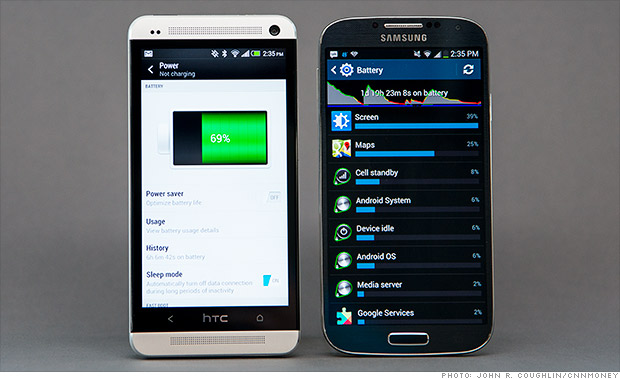
Aspects of Battery
Samsung Galaxy S4 VS HTC One Battery
That bigger, 2,600 mAh battery of the Galaxy S4 can get you a few extra hours of life than the HTC One.

But a bigger deal is the fact that the Galaxy S4 has a removable back panel and an interchangeable battery. If you're a real power user, you can carry a second battery around, and keep going. #Advantage: Samsung Galaxy S4

Aspects of Performance
Samsung Galaxy S4 VS HTC One Performance
In day-to-day usage, there's little noticeable difference between the two phones. They both have the same generation Snapdragon processor, after all.

But if you want to get into technicalities, the Galaxy S4 chipset runs at a higher 1.9 GHz clock speed (compared to the HTC One's 1.6 GHz). And in AnTuTu benchmark tests, the S4 beat the One every time on both the CPU and RAM fronts.

That's not the biggest deal for the technologically ambivalent, but for gamers and tinkerers, that little extra boost could come in handy. #Advantage: Samsung Galaxy S4

The Winner Of Comparison is HTC One
You can't really go wrong with either phone, but when it comes to features you'll actually notice on a day to day basis, the HTC one edges out the Galaxy S4.

It may be superficial, but just like buying a nice car, there's a certain joy to be had from quality workmanship. And if you're staunchly opposed to the Sense UI, and if know your way around technology, you can always "root" the device and run the stock Android operating system on it.

*Note:The overall winner of the views held htc one aspect, it may change, depending on your beliefs and your interests

Samsung Galaxy S4 vs HTC One - Army of two
Samsung Galaxy S4 VS HTC One Army Of Two
By now you should have formed an opinion of which phone you like better - each had moments where it shined and got overshadowed elsewhere. The truth is that this will be one of the most exciting fights in the premium segment this season. Yes, The Samsung Galaxy S4 and the HTC One are targeting the same market but will end up in the hands of completely different people. And it will be decided by the subtlest of differences. The blessing and the curse of being a flagship.

The HTC One is perhaps easier to define - not least because a premium device has a matching premium feel. That along with features like Beats Audio and BlinkFeed will probably make the HTC One a favorite among the young crowd. Facebook and Twitter don't care much for multi-megapixel images anyway, so OIS and Zoe can really make all the difference there. Plus, the aluminum unibody is a fashion accessory for any occasion.
The Samsung Galaxy S4 on the other hand seems like it couldn't care less about looks. This is in a way a stronger statement than the exquisite build and finish of its rival. Samsung want to show that it's the essence that matters and overall the Korean flagship certainly has more going for it than its rival.

You see the Samsung Galaxy S4 won more of the key battles today - screen (bigger, slightly better quality), software (newer, more options, better performance) and still camera. It may have lost elsewhere, but it was never a distant second.
The HTC One on the other hand emerged on top in the video recording, music and social networking categories, but those were all narrow victories. And its still camera was really nowhere near the level of the Samsung Galaxy S4 13MP shooter. Ultrapixels or not, 4MP can barely rival 2010 flagships on most occasions.

In the end, it's best if you don't just count number of victories to know which smartphone is better than this other. Instead, you should use this article as a reference - focus on the features you care about and ignore the rest. While each category has a winner and a loser, the "loser" in this shootout will be envied by most other premium phones on the market for quite some time to come. The winner? How about the one with your name on it.

Saturday, May 4, 2013

HTC One Review And Specs - Android Phone

HTC One Review
HTC One Review To rival Samsung with its Galaxy S4 and Apple with its iPhone 5, HTC present one of its flagship mobile phone and camera FullHD screen favor Ultrapixel. He named as HTC, this smartphone also has a myriad of powerful features wrapped in a full metal body unibodi.

Design

Dimension: 137.4 x 68.2 x 9.3 mm, 143 grams; 3.5 mm audio port; microSIM slot, the power / lock, volume control, speaker; mic hole; dock connector, microUSB port, full metal body construction with zero gap. Super LCD3 touchscreen capacitive touchscreen, 16 million colors, 1080 x 1920 pixels, 4.7 inches (~ 469 ppi pixel density), Corning Gorilla Glass 2.

Screen sector is one of the seeded on HTC smartphones. With full HD resolution screen measuring 4.7 inch HTC has up to 470 PPI pixel density. These qualities make tampulan smoother and sharper screen.

Main Features

Dropbox, Facebook, Twitter, Flashlight, Kid Mode, News & Weather, Notes, PDF Viewer, Polaris Office, SoundHound, Stocks, TuneIn Radio
BlinkFeed addition, HTC also buried some of the features and applications such as in some top class smartphones. Call it Dropbox is already included. You simply log into your Dropbox account that has been pinned on the HTC, then you immediately get free 25GB of space for two years.

Excess
• Body Strong and Solid
• 4.7-inch screen with full HD resolution
• UltraPixel Camera
• 1.7GHz Quadcore
• HTC Sense 5.0

Shortage
• Prices are still relatively expensive

Conclusion
Although Indonesia had to wait quite a long time coming, but HTC is able to treat pencintanya with quality hardware and the features it has. When holding the phone HTC obviously much better with most smartphones that use plastic materials. Moreover, armed with features like UltraPixel technology first used on a camera phone and its Full HD screen. It is also more interesting is the overhaul of the interface, which is able to present a more user friendly.

Screen Shot Of HTC One Pictures
HTC One
HTC One Front
HTC One Beside
HTC One Back


HTC One Specs


DISPLAY Type Super LCD3 capacitive touchscreen, 16M colors
Size 1080 x 1920 pixels, 4.7 inches (~469 ppi pixel density)
Multitouch Yes
Protection Corning Gorilla Glass 2
- HTC Sense UI v5


GENERAL 2G Network GSM 850 / 900 / 1800 / 1900
3G Network HSDPA 850 / 900 / 1900 / 2100
4G Network LTE (market dependent)
SIM Micro-SIM
Announced 2013, February
Status Available. Released 2013, March

BODY Dimensions 137.4 x 68.2 x 9.3 mm (5.41 x 2.69 x 0.37 in)
Weight 143 g (5.04 oz)

SOUND Alert types Vibration, MP3, WAV ringtones
Loudspeaker Yes, with stereo speakers, built-in amplifiers
3.5mm jack Yes
- Beats Audio sound enhancement

MEMORY Card slot No
Internal 32/64 GB, 2 GB RAM

DATA GPRS Yes
EDGE Yes
Speed HSPA+; LTE, Cat3, 50 Mbps UL, 100 Mbps DL
WLAN Wi-Fi 802.11 a/ac/b/g/n, Wi-Fi Direct, DLNA, Wi-Fi hotspot
Bluetooth Yes, v4.0 with A2DP
NFC Yes (Market dependent)
Infrared port Yes
USB Yes, microUSB v2.0 (MHL)

CAMERA Primary 4 MP, 2688 x 1520 pixels, autofocus, LED flash
Features 1/3'' sensor size, 2µm pixel size, simultaneous HD video and image recording, geo-tagging, face and smile detection, optical image stabilization
Video Yes, 1080p@30fps, 720p@60fps, HDR, stereo sound rec., video stabilization
Secondary Yes, 2.1 MP, 1080p@30fps, HDR

FEATURES OS Android OS, v4.1.2 (Jelly Bean), upgradable to v4.2.2 (Jelly Bean)
Chipset Qualcomm APQ8064T Snapdragon 600
CPU Quad-core 1.7 GHz Krait 300
GPU Adreno 320
Sensors Accelerometer, gyro, proximity, compass
Messaging SMS (threaded view), MMS, Email, Push Email
Browser HTML5
Radio Stereo FM radio with RDS
GPS Yes, with A-GPS support and GLONASS
Java Yes, via Java MIDP emulator
Colors Black, Silver, Red
- SNS integration
- Dropbox (25 GB storage)
- Active noise cancellation with dedicated mic
- TV-out (via MHL A/V link)
- DivX/XviD/MP4/H.263/H.264/WMV player
- MP3/eAAC+/WMA/WAV/FLAC player
- Google Search, Maps, Gmail,
YouTube, Calendar, Google Talk
- Organizer
- Document viewer/editor
- Photo viewer/editor
- Voice memo/dial/commands
- Predictive text input

BATTERY Non-removable Li-Po 2300 mAh battery
Stand-by No official data
Talk time No official data
MISC SAR US 1.26 W/kg (head) 0.69 W/kg (body)
SAR EU 0.86 W/kg (head) 0.36 W/kg (body)

TESTS Display Contrast ratio: 1541:1 (nominal) / 2.504:1 (sunlight)
Loudspeaker Voice 69dB / Noise 66dB / Ring 75dB
Audio quality Noise -82.7dB / Crosstalk -80.9dB
Camera Photo / Video
Battery life Endurance rating 48h

Wednesday, March 20, 2013

Android (Operating System) History


Introducing Android 1.6
GAM - Android is a Linux-based operating system for mobile phones such as smartphones and tablet computers. Android provides an open platform for developers to create their own applications for use by a variety of mobile devices. Initially, Google Inc.. bought Android Inc.., newcomers who make software for mobile phones. Then to develop Android, formed the Open Handset Alliance, a consortium of 34 companies for hardware, software, and telecommunications, including Google, HTC, Intel, Motorola, Qualcomm, T-Mobile, and Nvidia.
Android All Device
Android Soldier

At the inaugural release of Android, 5 November 2007, with the Open Handset Alliance Android states support the development of open standards on mobile devices. On the other hand, Google released the Android code under the Apache license, a license software and open standard mobile device.
In this world there are two types of distributors operating system Android. The first fully supported by Google or Google Mail Services (GMS) and the second is completely free distribution without direct support Google's otherwise known as the Open Handset Distribution (OHD).

Android Of History

History Of Android


  • Cooperation with Android Inc.

In July 2005, Google works with Android Inc., A company located in Palo Alto, California United States. The founders of Android Inc.. working at Google, including Andy Rubin, Rich Miner, Nick Sears, and Chris White. At that time many consider the functions of Android Inc.. just as software on mobile phones. Since then rumors surfaced that Google was about to enter the mobile phone market. In the company Google, the team led by Rubin developed a program in charge of mobile devices supported by the Linux kernel. This shows an indication that Google is preparing for a competition in the mobile phone market.


  • The Initial Product

Evolution Android
Around September 2007 a ​​study reported that Google filed a patent application mobile phone (Google finally introduced the Nexus One, one of the GSM smart phone that uses the Android operating system. Cellular phone is manufactured by HTC Corporation and available in the market on January 5, 2010) .
On December 9, 2008, announced new members who join the work program Android ARM Holdings, Atheros Communications, manufactured by Asustek Computer Inc, Garmin Ltd, Softbank, Sony Ericsson, Toshiba Corp, and Vodafone Group Plc. As the formation of the Open Handset Alliance, OHA announced their first product, Android, mobile devices (mobile) which is a modified Linux kernel 2.6. Since Android was released many updates have been made in the form of bug fixes and the addition of new features.
The first phone that uses the Android operating system is the HTC Dream, which was released on October 22, 2008. At the end of 2009 is estimated at least in this world there are 18 types of mobile phones that use Android.

  • Android version 1.1
On March 9, 2009, Google released the Android version 1.1. Android version is equipped with an aesthetic update to the application, alarm clock, voice search (search sound), sending messages to Gmail, and email notification.

  • Android version 1.5 (Cupcake)

In mid-May 2009, Google re-released mobile phone using Android and the SDK (Software Development Kit) with version 1.5 (Cupcake). There are several updates including the addition of several features in this mobile version of the ability to record and watch videos with the camera mode, upload video to YouTube and pictures to Picasa directly from the phone, A2DP Bluetooth support, the ability to automatically connect to a Bluetooth headset, animation screen, and on-screen keyboard that can be adapted to the system.


  • Android version 1.6 (Donut)

Donut (version 1.6) was released in September by displaying the search process better than before, battery usage indicator and control applet VPN. Another feature is the gallery that allows the user to select the photos to be removed; cameras, camcorders and interface the gallery; CDMA / EVDO, 802.1x, VPN, Gestures, and a Text-to-speech engine; ability to dial contacts, technological change text to speech (not available on all phones; procurement VWGA resolution.


  • Android version 2.0/2.1 (Eclair)

On December 3, 2009 re-launched Android phones with version 2.0/2.1 (Eclair), changes made are hardware optimization, improved Google Maps 3.1.2, change the UI with a new browser and support for HTML5, the new list of contacts, support flash for the camera 3 , 2 MP, digital zoom, and Bluetooth 2.1.
To move quickly in the competition next generation devices, Google held a competition to invest with the best mobile applications (killer apps - leading applications). This competition with prizes $ 25,000 for each selected application developers. The competition was held over two stages each step selected 50 best applications.
With the growing and increasing number of Android handsets, a growing number of third parties who wish to distribute their applications to the Android operating system. Applications are transformed into the renowned Android operating system is Shazam, Backgrounds, and WeatherBug. The Android operating system in the internet site is also considered important to create native Android applications, for example by MySpace and Facebook.


  • Android version 2.2 (Froyo: Frozen Yogurt)

On May 20, 2010, the Android version 2.2 (Froyo) was launched. These changes are generally against previous versions include support for Adobe Flash 10.1, speed performance and application of 2 to 5 times faster, integration V8 JavaScript engine that used Google Chrome that speeds rendering capability in the browser, the application installation in SD Card, WiFi capabilities portable hotspot, and the ability to auto update in the Android Market.


  • Android version 2.3 (Gingerbread)

On December 6, 2010, the Android version 2.3 (Gingerbread) was launched. General changes obtained from the Android version, among other upgrades games (gaming), improved copy and paste function, the display interface (User Interface) redesigned, support for video formats VP8 and WebM, new audio effects (reverb, equalization, headphone virtualization, and bass boost), support the ability of Near Field Communication (NFC), and the number of cameras support more than one.


  • Android version 3.0/3.1 (Honeycomb)

Android Honeycomb is designed specifically for tablets. Android version supports larger screen sizes. User Interface on Honeycomb is also different because it is designed for tablets. Honeycomb also supports multi-processor and hardware acceleration (hardware) for graphics. The first tablet to run Honeycomb is the Motorola Xoom. Tablet device with Android 3.0 platform will be coming soon in Indonesia. The device named Eee Pad Transformer production from Asus. Indonesia plans to enter the market in May 2011.


  • Android version 4.0 (ICS: Ice Cream Sandwich)

Announced on October 19, 2011, brought Honeycomb features to smartphones and added new features including facial recognition unlock with, network data usage monitoring and control, unified social networking contacts, photography enhancements, offline email search, and share information using NFC . The first phone that uses the operating system is Samsung Galaxy Nexus.


  • Android version 4.1 (Jelly Bean)

Android Jelly Bean that launched at the recent Google I / O and brings a number of advantages and new features. The new additions include increased input keyboard, the new design features of the search, new UI and search through Voice Search is faster. Not to forget Google Now also a section updated. Google Now give the right information at the right time anyway. One is the ability to check the weather, the traffic, or the results of sporting events. The operating system Android 4.1 Jelly Bean first appeared in the Asus tablet product, the Google Nexus 7.

  • Android version 4.2 (Jelly Bean)

Feature photo for panaroma sphere, daydream as a screensaver, power control, lock screen widget, run a lot of users (in tablets only), the latest widget.
Android 4.2 was first introduced by LG Google Nexus 4

All Android Version

Features Of Android


Features available on Android are:

  • Framework application: it allows the use and removal of components available.
  • Dalvik virtual machine: a virtual machine optimized for mobile devices.
  • Graph: graphs in 2D and 3D graphics library based on OpenGL.
  • SQLite: for data storage.
  • Supporting media: audio, video, and various image formats (MPEG4, H.264, MP3, AAC, AMR, JPG, PNG, GIF)
  • GSM, Bluetooth, EDGE, 3G, 4G, and WiFi (hardware dependent)
  • Cameras, Global Positioning System (GPS), compass, NFC, and accelerometer (hardware dependent)
Features Of Android
Features Of Android
Features Of Android

Android is open source communities


Android has various advantages as software that uses computer code base that can be distributed openly (open source) so that users can create new applications in it. Android has native applications such as integrated Google Gmail push email, Google Maps, and Google Calendar.
The fans then build open source communities to build and share Android-based firmware with a number of adjustments and additional features, such as FLAC lossless audio and the ability to save downloaded apps to the microSD card. They often update the firmware packages and combines elements of Android functionality that have not been officially launched in a carrier-sanction firmware.


Thanks For you visit, come back i am waiting....