Showing posts with label Samsung. Show all posts

Thursday, June 20, 2013

Samsung Galaxy Note 2 Review | Specs | Price

Samsung Galaxy Note 2 Review | Specs | Price
Samsung Galaxy Note 2 Review | Specs | Price : Attention is now focused Android smartphone to Samsung, because this vendor country ginseng is the market leader for Android devices. The emergence of a new variant called Phablet (phone-tablet) Samsung Galaxy Note launches his first success. Penetrate 10 million units since it was introduced in October last year, Samsung finally spawned a second generation of the so-called code name (N7100). What are the differences?

Samsung Galaxy Note 2 Review

Samsung Galaxy Note 2 Review
Dimension: 151.1 x 80.5 x 9.4 mm, 183 grams; full touchscreen; Hyperglaze technology; Material plastic and corning gorilla glass 2; 3.5mm audio jack, secondary mic; the power / lock; primary mic, microUSB port, S Pen Stylus slot; volume rocker (around phones from top) 1 physical home button and two touch buttons below the screen (menu and back). If seen from the shape Note the two is even more similar to the Galaxy S III. This is evident in the composition of the buttons and ports are identical. The difference is the addition of the S Pen on the port Note II.

Compared to its predecessor, Note II aka bongsor slightly higher but more slender. Like the Galaxy S III, Note II also uses Hyperglaze finishing which gives luxurious glossy display on the back cover of the phone.

The use of plastic materials in mobile phones can be understood, given the choice of a more luxurious materials will definitely have an impact on weight gain.

Note II equipped with a wider screen and a battery with significant additional power compared to its predecessor, but the addition of weight to within about 5 grams.

Conclusion
Excess
• slim design although bongsor
• Android Jellybean & TouchWiz UI
• Processor 1.6 GHz Quadcore
• Extra wide screen 5.5 inch HD Super AMOLED
• 8MP camera and full HD video

Shortage
• Prices are relatively expensive
• Plastic Body
• Without the shutter button

Conclusion
The broader screen with the latest Android version, super fast processor, superior camera is likely to be the successor of the successor is more successful than its predecessor. Moreover, the performance is somewhat better than the Galaxy S III. Unfortunately the price is less friendly dikantong. So if you want it get ready to spend more on.

Samsung Galaxy Note 2 Specs

GENERAL Network GSM 900/1800/1900 HSDPA 900/2100, LTE 850/1800/2100

DISPLAY Type Super AMOLED capacitive touchscreen, 16M colors
Size of 720 x 1280 pixels, 5.5 inches (~ 267 ppi pixel density), Multitouch, Corning Gorilla Glass 2, TouchWiz UI, Touch-sensitive controls, S Pen stylus

DIMENSIONS Size / Weight 151.1 x 80.5 x 9.4 mm / 183 g

AUDIO Vibration Feature
MP3, WAV ringtones
3.5mm audio jack
Speakerphone Yes

MEMORY Internal 16 GB storage, 2 GB of RAM
External Micro SD card slot up to 64GB
DATA 3G HSDPA, 21 Mbps; HSUPA, 5.76 Mbps; LTE, Cat3, 50 Mbps UL, 100 Mbps DL
EDGE Yes
GPRS Yes
WLAN Wi-Fi 802.11 a / b / g / n, dual-band, DLNA, Wi-Fi Direct, Wi-Fi hotspot
Bluetooth v4.0 with A2DP, LE, EDR
Infrared photo
USB / port microUSB (MHL) v2.0, USB Host support

CAMERA Primary 8 MP, 3264x2448 pixels, autofocus, LED flash. Features: Geo-tagging, touch focus, face and smile detection, image stabilization
Secondary 1.9 MP
Video Record Yes, 1080p @ 30fps

BATTERY Type Standard battery, Li-Ion 3100 mAh
Standby Up to 980 h (2G) / Up to 890 h (3G)
Talk Time Up to 35 h (2G) / Up to 16 h (3G)
FEATURES OS Android OS, v4.1.1 (Jelly Bean)

Exynos 4412 Quad CPU, Quad-core 1.6 GHz Cortex-A9 Mali-400MP GPU
HTML5 browsers
GPS Yes, A-GPS, GLONASS
Messaging SMS (threaded view), MMS, Email, Push Mail, IM
Java via Java MIDP emulator, Additional Features: S-Voice natural language commands and dictation - Stay Smart and Smart Rotate eye tracking - SNS integration - Active noise cancellation with dedicated mic - Dropbox (50 GB storage) - TV-out (via MHL A / V link), Organizer - Image / video editor - Document editor (Word, Excel, PowerPoint, PDF) - Google Search, Maps, Gmail, YouTube, Calendar, Google Talk, Picasa integration - Voice memo / dial / commands

OTHER FEATURES Multiple SIM MicroSIM card support only
Video Player MP4/DivX/XviD/WMV/H.264/H.263 player
MP3 Player MP3/WAV/eAAC + / AC3/FLAC player
Audio Record Yes
TV -

Samsung Galaxy Note 2 Price


#please Disable Your Adblock
Update Price Click Link Bellow
Samsung Galaxy Note II N7100 Unlocked GSM International Version White

Tuesday, June 18, 2013

Samsung Google Nexus 10 Review | Specs | Price

Samsung Google Nexus 10 Review | Specs | Price
Samsung Google Nexus 10 is a tablet computer developed by Google and Samsung Electronics. Samsung Google Nexus 10 Review This is the second disc in the Google Nexus series, a line of consumer devices implementing the Android operating system, which was built by the company's original equipment manufacturer (OEM) partners. After the success of the 7-inch Nexus 7 first Google Nexus tablet and 10 Nexus was released with a 10.1-inch, 1600 × 2560 pixel display, which in 2012 was the highest decision-screen tablet in the world. Nexus was announced on 10 October 29, 2012, and became available on November 13, 2012.

Device is available in two sizes for storage, 16 GB for $ 399 and 32 GB for $ 499. Along with mobile phone Nexus 4, Nexus 10 has launched version 4.2 ("Jelly Bean") of the robot, which provides the following new features: 360 degree panoramic image stitching called "Sphere Gallery"; quick settings menu; widgets on the lock screen; writing gesture; an updated version of Google Now, multiple user accounts for tablets.

The device was scheduled to be announced by Google on October 29, 2012, along with the Nexus 4 and Android 4.2, at a conference in New York City, but as a result of Hurricane Sandy, this event has been canceled. Instead, Google unveiled the device in an official blog post. Due to high demand, the device quickly store sale through Google Play. Nexus 10 passed repeated patterns of international availability via Google play the opponent, while the 32GB version was more consistent than stock. However, various reports indicate that the 32GB model is slowly coming back to markets such as the United States, United Kingdom, and Ireland.
Samsung Google Nexus 10 Pictures
Samsung Google Nexus 10
Google Nexus 10

Samsung Google Nexus 10 Specs

Screen
10.055” 2560 x 1600 (300 ppi)
WQXGA True RGB Real Stripe PLS
Corning® Gorilla® Glass 2

Dimensions
263.9 x 177.6 x 8.9mm
603g

Cameras
5 MP (main)
1.9 MP (front)

Processor and memory
16 GB or 32 GB internal storage (actual formatted capacity will be less)
2GB RAM
CPU: Dual-core A15
GPU: Quad-core Mali T604

Connectivity
WiFi 802.11 b/g/n (MIMO+HT40)
Bluetooth
NFC (Android Beam)
Dual side NFC
Micro USB
Magnetic Pogo pin charger
Micro HDMI
3.5mm headphone jack

Features
Android 4.2 (Jelly Bean)
9000 mAh Lithium polymer battery
Accelerometer
GPS
Gyroscope
Barometer
Ambient Light
Compass

Samsung Google Nexus 10 Price

Buy New $440.00
Or Click This Update Price
*Note: For View Price of Samsung Google Nexus 10, Please Disable your adblock

Wednesday, June 5, 2013

Root Samsung Galaxy Grand - Download + Tutorial

Root Samsung Galaxy Grand - Download + Tutorial
How To Easily Root Samsung Galaxy Grand - In this post, GoAndroidMarket will present an easy way Galaxy Grand root without any risk. Samsung GT-I9082 Galaxy Grand is one of the best Android Samsung output with a tag that did not make the bag burst. With prices reaching 4 million, this smartphone is equipped with advanced features like an 8 megapixel camera, Android 4.1 Jellybean, Wi-Fi and other advanced features

You Must Download Tool Of Root Samsung Galaxy Grand
Oddin
CMW Recovery
Fix Recovery
SuperSU

1. Installation process CWM Samsung Galaxy Grand

  • Download Odin file (link at bottom of page) and then extract it to your computer.
  • Enter into download mode by turning the phone off, then turn it on by pressing the key combination Volume Up, Home and Power simultaneously.
  • Open Odin and connect the phone using USB cable.
  • Check the ID: COM in Odin, if it is yellow then Galaxy Grand Odin recognizes your phone.
  • Click the PDA button in Odin and select the file you downloaded CWM.
  • Make sure only the Auto Reboot and F. Reset Time are checked, reserving the other is not checked.
  • Click the Start button to begin the flashing process, please wait for it to finish.
  • Do not pull the cord until it is complete.
  • Proceed to the second step below to perform rooting Samsung Galaxy Grand Duos

2. Root Samsung Galaxy Grand Processes

  • Make sure you have done a backup of the data on the phone before continuing the process of rooting your Galaxy Grand.
  • Copy all files that have been downloaded material from the link above into your SD card root.
  • Turn off your Galaxy Grand and go into recovery mode. To enter the way by simultaneously pressing the following buttons: volume up + home + power.
  • Using the volume keys, navigate to option "choose zip from sdcard" and select using the power button.
  • Then select the files that have been copied Fix Recovery.zip in SD card. After work, repeat step 4 but this time select the file SuperSU If the process successfully, then the Samsung Galaxy Grand root process is complete.
  • Choose menu Go back and select Reboot Now.
  • If you crash in Grand Galaxy Samsung logo when turned on, do not be confused. Sufficiently remove the phone battery and repeat the process once again.

To find out the process of rooting Samsung Galaxy Grand succeed, try to install applications that require root access like Root Explorer or any other application. If the tutorial is considered useful, do not forget to click the share or tweet button to share with your friends or relatives.

Sunday, May 5, 2013

Samsung Galaxy S4 VS HTC One Comparison

Samsung Galaxy S4 VS HTC One
Hi everyone, How Are you?... as usual, after I talk about a smart phone "HTC One Review And Specs", I try to compare it, Purpose nothing more than to see who is the best in all aspects of his supporters, both from the design until the smart phone usability, advantages and disadvantages of a smart phone is that I will compare "samsung galaxy s4 vs htc one" see the discussion following.

Aspects of Design
Samsung Galaxy S4 VS HTC One Design

On looks alone, the HTC One wipes the floor with the Samsung Galaxy S4. I'd argue it's the best designed Android phone ever. Deftly juggling size and weight with the use of more premium materials, the HTC One has a design that should even make Apple jealous. It's solid, but not too heavy. Thin, but not uncomfortable to hold.

The S4, on the other hand, is made of plastic and fake chrome. That said, it managed to fit a 5-inch screen and bigger battery into the same exact chassis as its predecessor. And it has a removable panel, offering access to the battery and microSD slot. That gives it some versatility the HTC One doesn't have. But that plastic. #Advantage: HTC One


Aspects of Software
Samsung Galaxy S4 VS HTC One Software
While the Galaxy S4 Touchwiz user interface is closer in spirit to the stock Android experience, it's so devoid of style or useful original ideas that you're left wondering why they felt the need to create their own operating system skin at all.

HTC's news-heavy Sense UI is really well done, but it has a more limited appeal. If you aren't particularly obsessed with news feeds and the pulse of the internet, Sense makes, well, no sense. #Advantage: Push

Aspects of Display
Samsung Galaxy S4 VS HTC One Display
On a technical level, the slightly smaller 4.7-inch screen of the HTC One gives it a higher pixel density than the 4.99-inch Galaxy S4: 469 pixels per inch vs 441 pixels per inch.

That means the HTC One is technically sharper. In the real world, however, it would take an obsessive person to notice the difference in clarity.

But the HTC One display is not only brighter than the Galaxy S4, it has a more accurate color profile too. That means photos and videos appear closer to the way your eye would have seen it in real life. #Advantage: HTC One

Aspects of Camera
Samsung Galaxy S4 VS HTC One Camera
In good lighting conditions, few cameras are capable of besting the 13 megapixel Galaxy S4. In low light however, the S4 stumbles more than it should.

The HTC One and its 4 megapixel UltraPixel sensor excel in low light, and though it's not the absolute best camera in natural life, it is certainly good enough.

Since most people don't really want to take the time to fiddle with limited camera phone settings, it's important to be able to fire off clear photos in dim settings. #Advantage: HTC One

Aspects of Battery
Samsung Galaxy S4 VS HTC One Battery
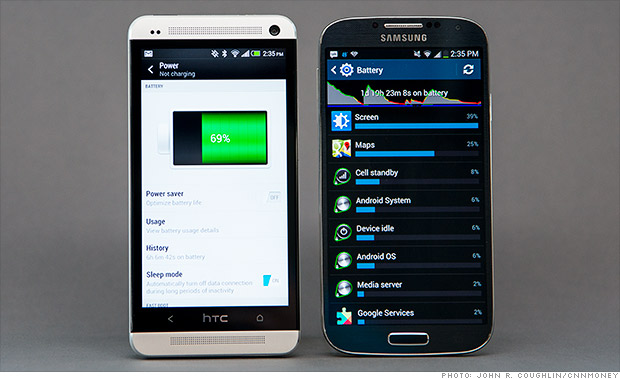
That bigger, 2,600 mAh battery of the Galaxy S4 can get you a few extra hours of life than the HTC One.

But a bigger deal is the fact that the Galaxy S4 has a removable back panel and an interchangeable battery. If you're a real power user, you can carry a second battery around, and keep going. #Advantage: Samsung Galaxy S4

Aspects of Performance
Samsung Galaxy S4 VS HTC One Performance
In day-to-day usage, there's little noticeable difference between the two phones. They both have the same generation Snapdragon processor, after all.

But if you want to get into technicalities, the Galaxy S4 chipset runs at a higher 1.9 GHz clock speed (compared to the HTC One's 1.6 GHz). And in AnTuTu benchmark tests, the S4 beat the One every time on both the CPU and RAM fronts.

That's not the biggest deal for the technologically ambivalent, but for gamers and tinkerers, that little extra boost could come in handy. #Advantage: Samsung Galaxy S4

The Winner Of Comparison is HTC One
You can't really go wrong with either phone, but when it comes to features you'll actually notice on a day to day basis, the HTC one edges out the Galaxy S4.

It may be superficial, but just like buying a nice car, there's a certain joy to be had from quality workmanship. And if you're staunchly opposed to the Sense UI, and if know your way around technology, you can always "root" the device and run the stock Android operating system on it.

*Note:The overall winner of the views held htc one aspect, it may change, depending on your beliefs and your interests

Samsung Galaxy S4 vs HTC One - Army of two
Samsung Galaxy S4 VS HTC One Army Of Two
By now you should have formed an opinion of which phone you like better - each had moments where it shined and got overshadowed elsewhere. The truth is that this will be one of the most exciting fights in the premium segment this season. Yes, The Samsung Galaxy S4 and the HTC One are targeting the same market but will end up in the hands of completely different people. And it will be decided by the subtlest of differences. The blessing and the curse of being a flagship.

The HTC One is perhaps easier to define - not least because a premium device has a matching premium feel. That along with features like Beats Audio and BlinkFeed will probably make the HTC One a favorite among the young crowd. Facebook and Twitter don't care much for multi-megapixel images anyway, so OIS and Zoe can really make all the difference there. Plus, the aluminum unibody is a fashion accessory for any occasion.
The Samsung Galaxy S4 on the other hand seems like it couldn't care less about looks. This is in a way a stronger statement than the exquisite build and finish of its rival. Samsung want to show that it's the essence that matters and overall the Korean flagship certainly has more going for it than its rival.

You see the Samsung Galaxy S4 won more of the key battles today - screen (bigger, slightly better quality), software (newer, more options, better performance) and still camera. It may have lost elsewhere, but it was never a distant second.
The HTC One on the other hand emerged on top in the video recording, music and social networking categories, but those were all narrow victories. And its still camera was really nowhere near the level of the Samsung Galaxy S4 13MP shooter. Ultrapixels or not, 4MP can barely rival 2010 flagships on most occasions.

In the end, it's best if you don't just count number of victories to know which smartphone is better than this other. Instead, you should use this article as a reference - focus on the features you care about and ignore the rest. While each category has a winner and a loser, the "loser" in this shootout will be envied by most other premium phones on the market for quite some time to come. The winner? How about the one with your name on it.

Monday, April 15, 2013

Samsung Galaxy S4 VS Sony Xperia Z Comparison

Samsung Galaxy S4 VS Sony Xperia Z

Previously, I had written about Samsung Galaxy S4 and Sony Xperia Z, well this time I tried to compare the two smart phones, all comparisons of all aspects of the advantages and disadvantages of each smart phone.

See The Following Comparison

The Sony Xperia Z is already available across different regions of the world and on multiple carriers while the Samsung Galaxy S4 is due for a release across the world from late April. It looks as though the Galaxy S4 will hit the UK first on April 26 and then will also then release on multiple US carriers with T-Mobile being the first to announce availability coming on May 1. We’ll look at some of the key specs and details for each phone first, followed by an overall summary.

Processor
The Samsung Galaxy S4 has either a 1.6GHz Exynox Octa-core processor or a 1.9GHz Qualcomm Snapdragon 600 quad-core processor, dependent on market. It also has PowerVR SGX 544MP3 graphics or Adreno 320 graphics, again dependent on market model.
The Sony Xperia Z has a 1.5GHz Qualcomm quad-core processor with Adreno 320 GPU.

Display
The Galaxy S4 totes a 5-inch Super AMOLED display with resolution of 1920 x 1080 and a whopping 441 ppi. On the other hand. 
The Xperia Z has a 5-inch TFT display with resolution of 1920 x 1080 and again that hugely impressive 441 ppi. As you can see there’s very little between them so far.

RAM and Storage
You’ll find 2GB of RAM for the Galaxy S4 and 16, 32 or 64GB internal storage options, expandable via microSD to 64GB. 
For the Xperia Z there’s also 2GB of RAM but only 16GB of internal storage, expandable via microSD to 64GB.

Camera Set-up
There’s a 13-megapixel rear camera with autofocus, LED flash, dual shot, simultaneous HD video and image capture, geo-tagging, touch focus, face and smile detection, image stabilization and HDR for the Galaxy S4. It’s also capable of 1080p @30fps video with dual-video recording and also has a 2-megapixel front-facing camera also with 1080p @30fps and also dual video call. 
Alternatively the Xperia Z has 13.1-megapixel rear camera with autofocus, LED flash, geo-tagging, touch focus, face detection, image stabilization, sweep panorama, HDR recording with 1080p video capture @30fps, image stabilization and HDR. It also sports a 2.2-megapixel front-facing camera also with 1080p @30fps.

Battery
The Galaxy S4 has a 2600 mAh battery while the Xperia Z has a 2330 mAh non-removable battery so the Galaxy S4 has the advantage here.

Operating System Android
Android 4.2.2 Jelly Bean will be the OS for the Galaxy S4 out of the box with Samsung’s TouchWiz UI also evident.
The Xperia Z released on Android 4.1.2 Jelly Bean and there’s a planned upgrade to 4.2. It also uses the Sony Bravia Engine 2.

Dimensions and Colors
Measurements of the Galaxy S4 are 136.6mm x 69.8mm x 7.9mm and it weighs 130g. It comes in White Frost or Black Mist color options but more colors may arrive later, as in the case of the Galaxy S3. 
The Xperia Z measures 139mm x 71mm x 7.9mm, weighs 146g and has black, white or purple color options.


Samsung Galaxy S4 VS Sony Xperia Z When World Collision
As you can see these two phones are pretty similar when it comes to specs with only some minor differences between them. They both also have LTE connectivity (on models where applicable), Bluetooth 4.0 with AD2P and NFC although the Xperia Z has Wi-Fi 802.11 a/b/g/n and the Galaxy S4 has the superior Wi-Fi 802.11 a/b/g/n/ac. However the Xperia Z is both water and dust resistant, something that the Galaxy S4 lacks.

Of course we haven’t room here to detail every single specification and also features of both phones and this is where some feel the Samsung Galaxy S4 pushes ahead. As well as wireless charging (some markets) the Galaxy S4 has some amazing new features and improvements such as Smart Stay, Smart Scroll and Smart Pause and further enhancements to S Voice.

Design and build may also play a part in any decision you make between these two handset and on a personal level we’d say the Xperia Z wins this hands down with an elegant sleek design, top-end materials and all-round premium look and feel whereas once more the new Galaxy S handset features plastic and more plastic as on previous Galaxy S phones. Pricing for the Galaxy S4 is only just being announced in dribs and drabs for different regions and carriers but it likely to be around the same price as the Xperia Z or maybe just slightly more.
Samsung Galaxy S4

Sony Xperia Z

Samsung Galaxy S4

Sony Xperia Z

We say that both of these phones have a huge amount to offer consumers. Although the Galaxy S4 will undoubtedly become the bigger seller (such is the dominance of Samsung for Android devices) that doesn’t mean the Xperia Z doesn’t more than live up to its billing of being Sony’s flagship device. Both phones will offer users a fine mobile experience and should keep users satisfied and happy with their choice. If innovative features are important to you then the Galaxy S4 might be the right choice for you. However, if you want a good-looking phone that looks and feels good the Xperia Z may suit you better.

i also comparing between Samsung Galaxy s4 vs LG Nexus 4 Compared  What do you Think?

Friday, April 12, 2013

Samsung GALAXY S4 Review And Specs - Android Phone

Samsung GALAXY S4
Samsung released its newest flagship smartphone Galaxy S IV. which is equipped with a 5-inch screen Full HD Super AMOLED display with a resolution of 1920 x 1080 pixels, which adds up to a pixel density of 441ppi.

international version of the Samsung Galaxy S IV is also equipped with Exynos chipset Octa 5 to feature four Cortex-A15 cores at 1.6GHz speed, four Cortex-A7 cores running at 1.2GHz speeds and GPU PowerVR SGX 544MP3. There will be two other versions for some markets, which will be powered by Qualcomm Snapdragon chipset with a 600 4 300 Krait cores and Adreno 320 GPU, Both versions will offer LTE connectivity, and 2GB of RAM.

Behind, the Samsung Galaxy S IV put 13 MP camera, while the front 2.1MP resolution that can be used for video chats and a number of new features that involve eye-tracking and hand tracking.

Samsung Galaxy S IV has a dimension that is thinner than the Galaxy S III with 7.9 mm, though the screen is bigger but is actually smaller than its predecessor thanks to a slim bezel. This smartphone has finishing hyperglaze on the body similar to its predecessor, except that it has a different pattern on the back. Although using the same materials and batteries battery with a larger capacity (2600mAh) Galaxy S IV even lighter than the Galaxy S III, which is 130gram.

Samsung's flagship smartphone flagship has three internal storage options (16GB, 32GB and 64GB) and all of them will be equipped with a microSD slot.

Samsung Galaxy S IV runs with Android 4.2.2 and Jelly Bean has some cool new software features, such as Sound And Shot, Shot Drama, Cinema Photo, S Translator, Smart Pause, Health and Wellness

Screen Shot Of Samsung Galaxy S4 pictures
Samsung GALAXY S4
Samsung GALAXY S4
Samsung GALAXY S4
Samsung GALAXY S4
Samsung GALAXY S4
Samsung GALAXY S4

Samsung Galaxy S4 Specs


DISPLAY Type Super AMOLED capacitive touchscreen, 16M colors
Size 1080 x 1920 pixels, 5.0 inches (~441 ppi pixel density)
Multitouch Yes
Protection Corning Gorilla Glass 3
- TouchWiz UI

GENERAL 2G Network GSM 850 / 900 / 1800 / 1900
3G Network HSDPA 850 / 900 / 1900 / 2100
4G Network LTE
SIM Micro-SIM
Announced 2013, March

DESIGN Dimensions 136.6 x 69.8 x 7.9 mm (5.38 x 2.75 x 0.31 in)
Weight 130 g (4.59 oz)
Os Android 4.2.2 (Jelly Bean)

SOUND Alert types Vibration; MP3, WAV ringtones
Loudspeaker

HARDWARE
System chip: Exynos 5 Octa
Processor: 8-core, 1600 MHz, (1.6 GHz quad-core ARM Cortex-A15 and 1.2 GHz quad-core ARM Cortex-A7)
Graphics processor: PowerVR SGX544MP3
System memory: 2048 MB RAM
Built-in storage: 16 GB
Storage expansion: microSD, microSDHC, microSDXC up to 64 GB


Samsung Galaxy S4 Video Review

Wednesday, March 20, 2013

Android (Operating System) History


Introducing Android 1.6
GAM - Android is a Linux-based operating system for mobile phones such as smartphones and tablet computers. Android provides an open platform for developers to create their own applications for use by a variety of mobile devices. Initially, Google Inc.. bought Android Inc.., newcomers who make software for mobile phones. Then to develop Android, formed the Open Handset Alliance, a consortium of 34 companies for hardware, software, and telecommunications, including Google, HTC, Intel, Motorola, Qualcomm, T-Mobile, and Nvidia.
Android All Device
Android Soldier

At the inaugural release of Android, 5 November 2007, with the Open Handset Alliance Android states support the development of open standards on mobile devices. On the other hand, Google released the Android code under the Apache license, a license software and open standard mobile device.
In this world there are two types of distributors operating system Android. The first fully supported by Google or Google Mail Services (GMS) and the second is completely free distribution without direct support Google's otherwise known as the Open Handset Distribution (OHD).

Android Of History

History Of Android


  • Cooperation with Android Inc.

In July 2005, Google works with Android Inc., A company located in Palo Alto, California United States. The founders of Android Inc.. working at Google, including Andy Rubin, Rich Miner, Nick Sears, and Chris White. At that time many consider the functions of Android Inc.. just as software on mobile phones. Since then rumors surfaced that Google was about to enter the mobile phone market. In the company Google, the team led by Rubin developed a program in charge of mobile devices supported by the Linux kernel. This shows an indication that Google is preparing for a competition in the mobile phone market.


  • The Initial Product

Evolution Android
Around September 2007 a ​​study reported that Google filed a patent application mobile phone (Google finally introduced the Nexus One, one of the GSM smart phone that uses the Android operating system. Cellular phone is manufactured by HTC Corporation and available in the market on January 5, 2010) .
On December 9, 2008, announced new members who join the work program Android ARM Holdings, Atheros Communications, manufactured by Asustek Computer Inc, Garmin Ltd, Softbank, Sony Ericsson, Toshiba Corp, and Vodafone Group Plc. As the formation of the Open Handset Alliance, OHA announced their first product, Android, mobile devices (mobile) which is a modified Linux kernel 2.6. Since Android was released many updates have been made in the form of bug fixes and the addition of new features.
The first phone that uses the Android operating system is the HTC Dream, which was released on October 22, 2008. At the end of 2009 is estimated at least in this world there are 18 types of mobile phones that use Android.

  • Android version 1.1
On March 9, 2009, Google released the Android version 1.1. Android version is equipped with an aesthetic update to the application, alarm clock, voice search (search sound), sending messages to Gmail, and email notification.

  • Android version 1.5 (Cupcake)

In mid-May 2009, Google re-released mobile phone using Android and the SDK (Software Development Kit) with version 1.5 (Cupcake). There are several updates including the addition of several features in this mobile version of the ability to record and watch videos with the camera mode, upload video to YouTube and pictures to Picasa directly from the phone, A2DP Bluetooth support, the ability to automatically connect to a Bluetooth headset, animation screen, and on-screen keyboard that can be adapted to the system.


  • Android version 1.6 (Donut)

Donut (version 1.6) was released in September by displaying the search process better than before, battery usage indicator and control applet VPN. Another feature is the gallery that allows the user to select the photos to be removed; cameras, camcorders and interface the gallery; CDMA / EVDO, 802.1x, VPN, Gestures, and a Text-to-speech engine; ability to dial contacts, technological change text to speech (not available on all phones; procurement VWGA resolution.


  • Android version 2.0/2.1 (Eclair)

On December 3, 2009 re-launched Android phones with version 2.0/2.1 (Eclair), changes made are hardware optimization, improved Google Maps 3.1.2, change the UI with a new browser and support for HTML5, the new list of contacts, support flash for the camera 3 , 2 MP, digital zoom, and Bluetooth 2.1.
To move quickly in the competition next generation devices, Google held a competition to invest with the best mobile applications (killer apps - leading applications). This competition with prizes $ 25,000 for each selected application developers. The competition was held over two stages each step selected 50 best applications.
With the growing and increasing number of Android handsets, a growing number of third parties who wish to distribute their applications to the Android operating system. Applications are transformed into the renowned Android operating system is Shazam, Backgrounds, and WeatherBug. The Android operating system in the internet site is also considered important to create native Android applications, for example by MySpace and Facebook.


  • Android version 2.2 (Froyo: Frozen Yogurt)

On May 20, 2010, the Android version 2.2 (Froyo) was launched. These changes are generally against previous versions include support for Adobe Flash 10.1, speed performance and application of 2 to 5 times faster, integration V8 JavaScript engine that used Google Chrome that speeds rendering capability in the browser, the application installation in SD Card, WiFi capabilities portable hotspot, and the ability to auto update in the Android Market.


  • Android version 2.3 (Gingerbread)

On December 6, 2010, the Android version 2.3 (Gingerbread) was launched. General changes obtained from the Android version, among other upgrades games (gaming), improved copy and paste function, the display interface (User Interface) redesigned, support for video formats VP8 and WebM, new audio effects (reverb, equalization, headphone virtualization, and bass boost), support the ability of Near Field Communication (NFC), and the number of cameras support more than one.


  • Android version 3.0/3.1 (Honeycomb)

Android Honeycomb is designed specifically for tablets. Android version supports larger screen sizes. User Interface on Honeycomb is also different because it is designed for tablets. Honeycomb also supports multi-processor and hardware acceleration (hardware) for graphics. The first tablet to run Honeycomb is the Motorola Xoom. Tablet device with Android 3.0 platform will be coming soon in Indonesia. The device named Eee Pad Transformer production from Asus. Indonesia plans to enter the market in May 2011.


  • Android version 4.0 (ICS: Ice Cream Sandwich)

Announced on October 19, 2011, brought Honeycomb features to smartphones and added new features including facial recognition unlock with, network data usage monitoring and control, unified social networking contacts, photography enhancements, offline email search, and share information using NFC . The first phone that uses the operating system is Samsung Galaxy Nexus.


  • Android version 4.1 (Jelly Bean)

Android Jelly Bean that launched at the recent Google I / O and brings a number of advantages and new features. The new additions include increased input keyboard, the new design features of the search, new UI and search through Voice Search is faster. Not to forget Google Now also a section updated. Google Now give the right information at the right time anyway. One is the ability to check the weather, the traffic, or the results of sporting events. The operating system Android 4.1 Jelly Bean first appeared in the Asus tablet product, the Google Nexus 7.

  • Android version 4.2 (Jelly Bean)

Feature photo for panaroma sphere, daydream as a screensaver, power control, lock screen widget, run a lot of users (in tablets only), the latest widget.
Android 4.2 was first introduced by LG Google Nexus 4

All Android Version

Features Of Android


Features available on Android are:

  • Framework application: it allows the use and removal of components available.
  • Dalvik virtual machine: a virtual machine optimized for mobile devices.
  • Graph: graphs in 2D and 3D graphics library based on OpenGL.
  • SQLite: for data storage.
  • Supporting media: audio, video, and various image formats (MPEG4, H.264, MP3, AAC, AMR, JPG, PNG, GIF)
  • GSM, Bluetooth, EDGE, 3G, 4G, and WiFi (hardware dependent)
  • Cameras, Global Positioning System (GPS), compass, NFC, and accelerometer (hardware dependent)
Features Of Android
Features Of Android
Features Of Android

Android is open source communities


Android has various advantages as software that uses computer code base that can be distributed openly (open source) so that users can create new applications in it. Android has native applications such as integrated Google Gmail push email, Google Maps, and Google Calendar.
The fans then build open source communities to build and share Android-based firmware with a number of adjustments and additional features, such as FLAC lossless audio and the ability to save downloaded apps to the microSD card. They often update the firmware packages and combines elements of Android functionality that have not been officially launched in a carrier-sanction firmware.


Thanks For you visit, come back i am waiting....